
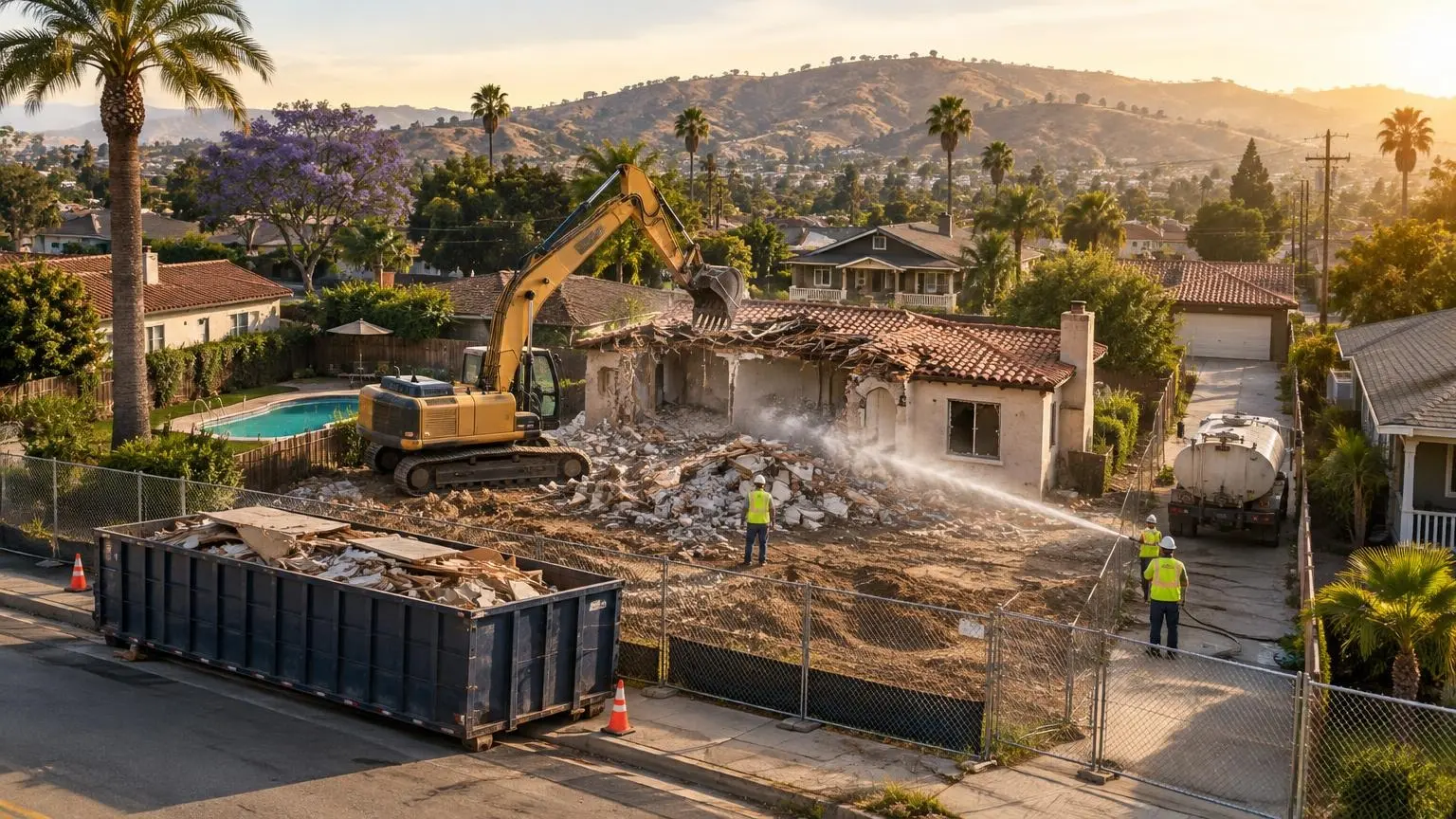
Teardowns, pools, slabs and strip-outs
Demolition Contractors in Los Angeles, CA
Permits, asbestos surveys and utility cut-offs lined up, then the structure taken down and the site left ready to build.
- Free walk-through and written, itemized estimate
- Asbestos survey, air district notice and utility cut-offs sequenced before demolition
- Concrete, metal and wood separated for recycling
Demolition Done in the Right Order
Elite Demolition Contractors Los Angeles takes down houses, detached garages, pools, concrete and interiors across the city of Los Angeles and the cities around it. Los Angeles covers about 469 square miles of land, from flat grids of 1920s bungalows to hillside lots on narrow, winding streets, and almost every demolition here starts with the same question: what has to happen before the first wall comes down? For demolition contractors in Los Angeles, the answer is a set of permits, surveys and disconnects that have to land in the right order, and that is where most delays come from.
What you can hire us for
- House demolition: full teardowns of single-family homes and duplexes, including foundations and slabs.
- Garage and shed removal: detached garages, carports, sheds and patio covers, often cleared for an ADU.
- Pool removal: partial fill-in or full removal of in-ground pools and spas, with compacted backfill.
- Concrete removal: driveways, patios, walkways, slabs, footings and block walls.
- Interior demolition: kitchen and bath tear-outs, wall removal and whole-house gut-outs.
- Commercial demolition: tenant improvement strip-outs, restaurant demolition and small building teardowns.
The permit path inside city limits
The Los Angeles Department of Building and Safety lays out its demolition rules in Information Bulletin P/BC 2026-039, revised January 1, 2026. The main points for a property owner:
- Each building or structure needs its own demolition permit, and an inspector visits the site before it is issued.
- If the building has a sewer line, a sewer cap permit comes first, and the cap is inspected before it is buried.
- For buildings 45 years or older, LADBS mails notice to the abutting owners and occupants, the Council District office and the Neighborhood Council, then waits at least 30 days before issuing the permit.
- A NOTICE OF DEMOLITION placard goes up near the front property line. A detached garage being replaced by an ADU is exempt from the placard unless it sits in a significant historic district.
- Protected trees need clearance from the Urban Forestry Division, and lots in a Historic Preservation Overlay Zone may need HPOZ clearance.
Air quality rules apply too. South Coast AQMD Rule 1403 requires an asbestos survey by a Cal/OSHA certified inspector and notice to the air district no later than 10 working days before demolition begins. Gas and electric service are shut off by the utilities. We put all of this on one schedule, so you know the real start date before you sign.
Why older Los Angeles buildings need a closer look
Los Angeles housing is older than many people expect. Census figures summarized by Point2Homes put the median year built at 1965. About 19 percent of homes date from 1939 or earlier, and roughly 70 percent were built before 1980. Buildings of that age often carry asbestos in flooring, ceilings, stucco, roofing or pipe wrap, and lead in old paint. That is why the survey comes before the price is final: abatement changes both the cost and the schedule, and it is better to know up front.
Debris has to go to the right place
A single house can fill many truckloads with stucco, framing, drywall, roofing, concrete and metal. Inside the city, the Citywide Construction and Demolition Waste Recycling Ordinance (No. 181519) requires mixed demolition debris to be hauled only to City-certified processing facilities. LA Sanitation says penalties can reach $5,000 per load taken elsewhere. We separate concrete and metal where we can, since both are recycled, and haul the rest to certified facilities.
Working on crowded blocks and hillside streets
Los Angeles is a hard place to stage a demolition. Lots are tight, neighbors are close, street parking is scarce, and many hillside roads cannot take full-size trucks. We size trucks and containers to the street, keep dust down with water, sweep the sidewalk and street, and keep neighbors' driveways open. LADBS lists permitted construction and demolition hours of 7:00 a.m. to 9:00 p.m. on weekdays and 8:00 a.m. to 6:00 p.m. on Saturdays, with no work on Sundays, and we schedule the loud work inside those windows.
Why so many garages and pools are coming out
Two kinds of demolition keep growing in Los Angeles. The first is the detached garage. Crosstown's analysis of LADBS permit data found the city permitted 6,626 accessory dwelling units in 2024, the second-highest count on record, with ADUs making up about 43 percent of new permitted units. Many of those units go where an old garage stood. The second is the backyard pool. When a pool is no longer used, owners often fill it in or remove it to get the yard back, and the choice between those two affects what can be built there later. Both have their own service pages with costs and details.
What happens when you call
Walk-through. We look at the structure, the lot, the access, the trees and the neighbors, and ask what you plan to build next.
Written estimate. The price lists the scope line by line: permits and notices, survey, disconnects, demolition, foundation work, hauling and grading.
Scheduling. We sequence the survey, notices, sewer cap and permit, and give you a realistic start date.
Demolition and cleanup. The structure comes down, debris is hauled, and the site is rough-graded and handed back with the permit signed off. Call (213) 377-6198 to set up a walk-through.
Why Homeowners Call Elite Demolition Contractors Los Angeles
Permits in sequence
Asbestos survey, air district notice, sewer cap and LADBS permit lined up so the start date holds.
Itemized estimates
Each line shows what comes out, what stays and how the debris is handled.
Hazards checked first
With most of the city's homes built before 1980, we plan for asbestos and lead before pricing is final.
Debris to certified facilities
Mixed debris goes to City-certified processors, as the city's C&D recycling ordinance requires.
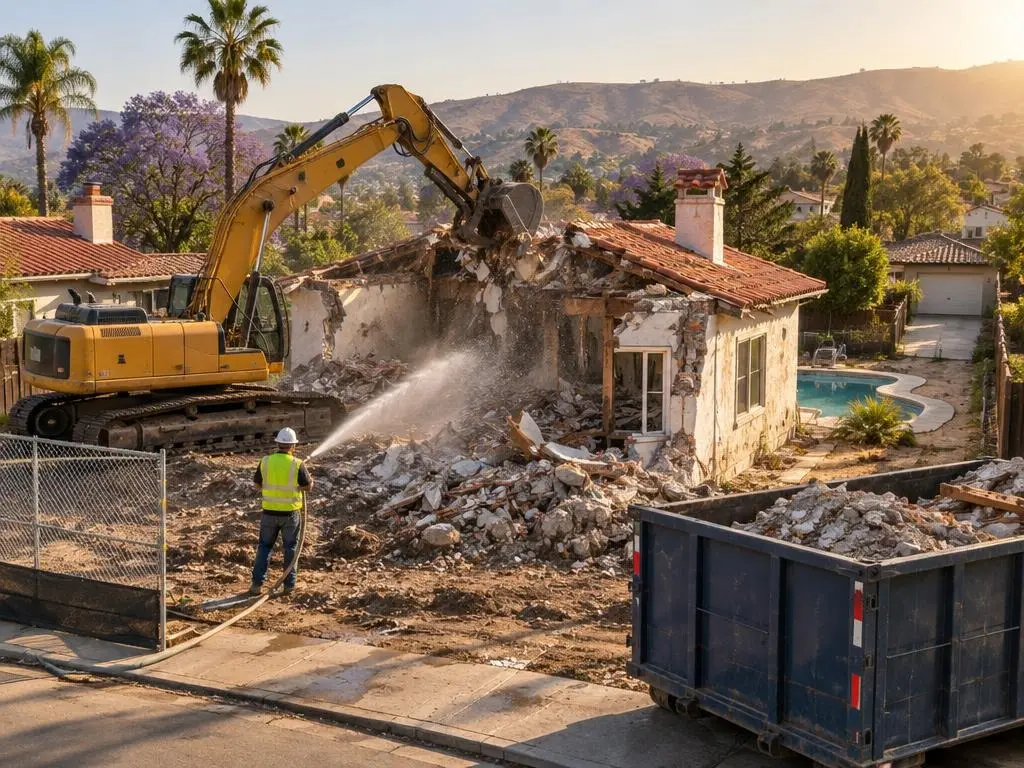
Where We Work
Our home base is the city of Los Angeles, from the Valley to the Westside, the Eastside and South LA. We also work in the larger cities around it: Glendale, Burbank and Pasadena to the north and east, Santa Monica, Culver City, Beverly Hills and West Hollywood to the west, and Inglewood, Torrance and Long Beach to the south. One thing that sets these places apart is that each city outside Los Angeles has its own building department and its own demolition permit process, so the LADBS steps described here apply only inside Los Angeles city limits. Each town page covers what we found about that place's housing and rules.
- Demolition Contractors in Los Angeles, CA
- Demolition Contractors in Long Beach, CA
- Demolition Contractors in Glendale, CA
- Demolition Contractors in Pasadena, CA
- Demolition Contractors in Torrance, CA
- Demolition Contractors in Burbank, CA
- Demolition Contractors in Inglewood, CA
- Demolition Contractors in Downey, CA
- Demolition Contractors in West Covina, CA
- Demolition Contractors in El Monte, CA
- Demolition Contractors in Norwalk, CA
- Demolition Contractors in Compton, CA
- Demolition Contractors in Carson, CA
- Demolition Contractors in South Gate, CA
- Demolition Contractors in Santa Monica, CA
- Demolition Contractors in Whittier, CA
- Demolition Contractors in Hawthorne, CA
- Demolition Contractors in Alhambra, CA
- Demolition Contractors in Lakewood, CA
- Demolition Contractors in Redondo Beach, CA
- Demolition Contractors in Gardena, CA
- Demolition Contractors in Arcadia, CA
- Demolition Contractors in Altadena, CA
- Demolition Contractors in Culver City, CA
- Demolition Contractors in West Hollywood, CA
- Demolition Contractors in Manhattan Beach, CA
- Demolition Contractors in Beverly Hills, CA
Our Demolition Services
Six kinds of demolition, from a single slab to a whole house, each planned around Los Angeles permits and debris rules.
House Demolition
Full teardowns of single-family homes, duplexes and their foundations, from utility cut-off paperwork to a cleared, graded lot.
Learn more →Garage & Shed Removal
Detached garages, carports, sheds, guest houses and patio covers taken down and hauled, often to clear the way for an ADU.
Learn more →Pool Removal
In-ground pools and spas removed or filled in with compacted fill, so the backyard can be used again and the ground can carry what goes on top.
Learn more →Concrete Removal
Driveways, patios, walkways, slabs and block walls broken out and hauled away, with the base left ready for new hardscape or planting.
Learn more →Interior Demolition
Kitchen, bath and whole-house gut-outs and selective demolition, taken back to studs or slab with the parts you are keeping protected.
Learn more →Commercial Demolition
Tenant improvement strip-outs, storefront and office demolition, and small commercial building teardowns, scheduled around businesses and neighbors.
Learn more →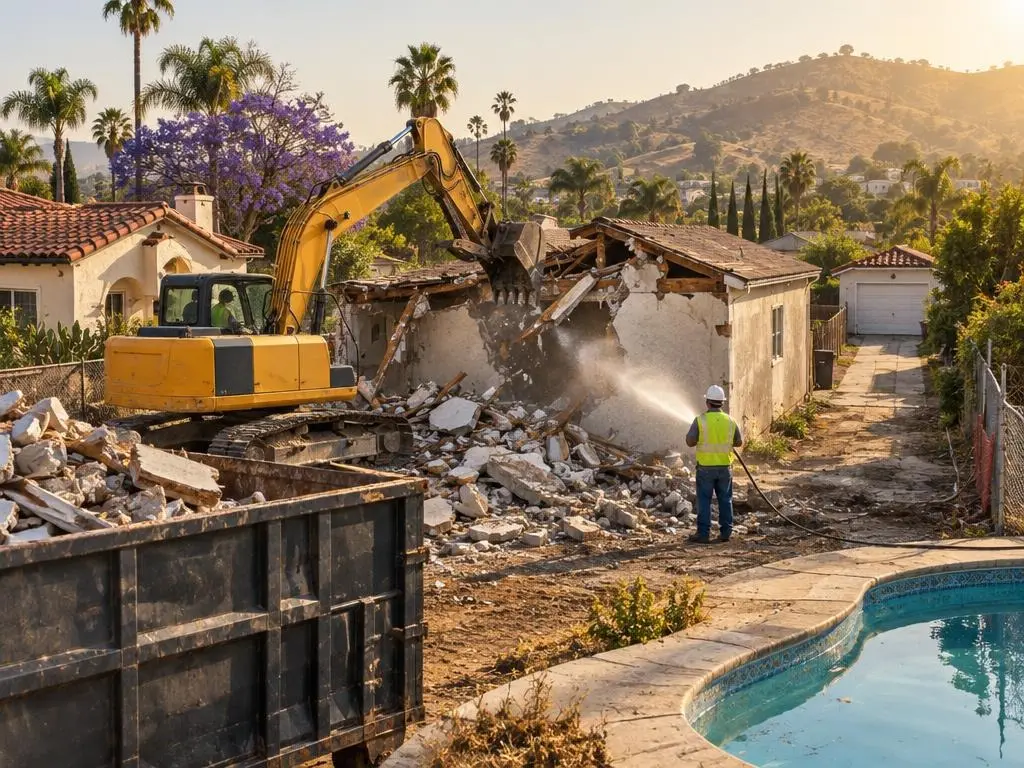
Common Questions
How much does demolition cost in California?
It depends on what is coming down. National guides give a useful starting point: HomeAdvisor lists house demolition at $4 to $17 a square foot and pool removal at $4,000 to $12,000, while Fixr lists concrete removal at $2 to $6 a square foot. Los Angeles labor, disposal and permit costs often push prices higher, so the written estimate after a walk-through is the real number.
What should I ask residential demolition contractors in Los Angeles?
Ask who handles the asbestos survey and air district notice, the sewer cap and the LADBS permit, and how long that sequence will take for a building your age. Ask whether the foundation and slab are included, what stays, and where the debris goes. LADBS issues demolition permits to licensed wrecking (C-21) or Class A contractors, so ask for the license number and check it with the Contractors State License Board.
Do I need a permit to demolish a house in Los Angeles?
Yes. LADBS requires a demolition permit for each building or structure, a pre-inspection, and a sewer cap permit first if the building has a sewer line. For buildings 45 years or older, the permit cannot be issued until at least 30 days after LADBS mails notice to neighbors, the Council District office and the Neighborhood Council.
Is an asbestos survey required before demolition?
Yes. South Coast AQMD Rule 1403 requires a survey by a Cal/OSHA certified inspector and notice to the air district no later than 10 working days before demolition begins. If asbestos is found, it is abated before the building comes down.
Do you handle commercial demolition in Los Angeles?
Yes. Most of our commercial work is tenant improvement strip-outs, restaurant demolition and small building teardowns. LADBS asks for more on commercial jobs than on houses, including plans for protecting adjacent property and the demolition sequence, and we work around building rules for hours and access.
How long does a demolition take?
The physical work for a typical house takes days to about two weeks, and a garage, pool or slab is often faster. The paperwork usually takes longer: the 10-working-day air district notice, the sewer cap, the pre-inspection and, for buildings 45 years or older, the 30-day notice period. We give you a realistic schedule at the estimate.
Are the same rules used in Glendale, Pasadena or Santa Monica?
No. Those cities, and most of the others around Los Angeles, have their own building departments, demolition permits and fees. The air district's Rule 1403 applies across the region, but the local permit steps differ, so we check the rules for your address.
What hours can demolition work happen in Los Angeles?
LADBS lists permitted construction and demolition hours of 7:00 a.m. to 9:00 p.m. Monday through Friday and 8:00 a.m. to 6:00 p.m. on Saturdays, with no work permitted on Sundays. Building managers and other cities may set tighter limits.
Get a Demolition Contractors Estimate
We walk the site, map out the permit steps and give you a written price anywhere in Los Angeles and the nearby cities.